


Yamaha R9 Performance Breakdown: Dyno Results, Ride Feel, and Tuning Potential Explained
The Yamaha R9 arrived with a lot of pressure behind it. Riders wanted to know if it was an R6 replacement, an R1 replacement, a faired MT-09, or something completely different. After riding it stock, testing it on GPS, running it on the dyno, flashing it with our BT Moto Yamaha R9 Stage 1+ ECU Flash with handheld tuner, and testing it again, the answer is pretty clear.
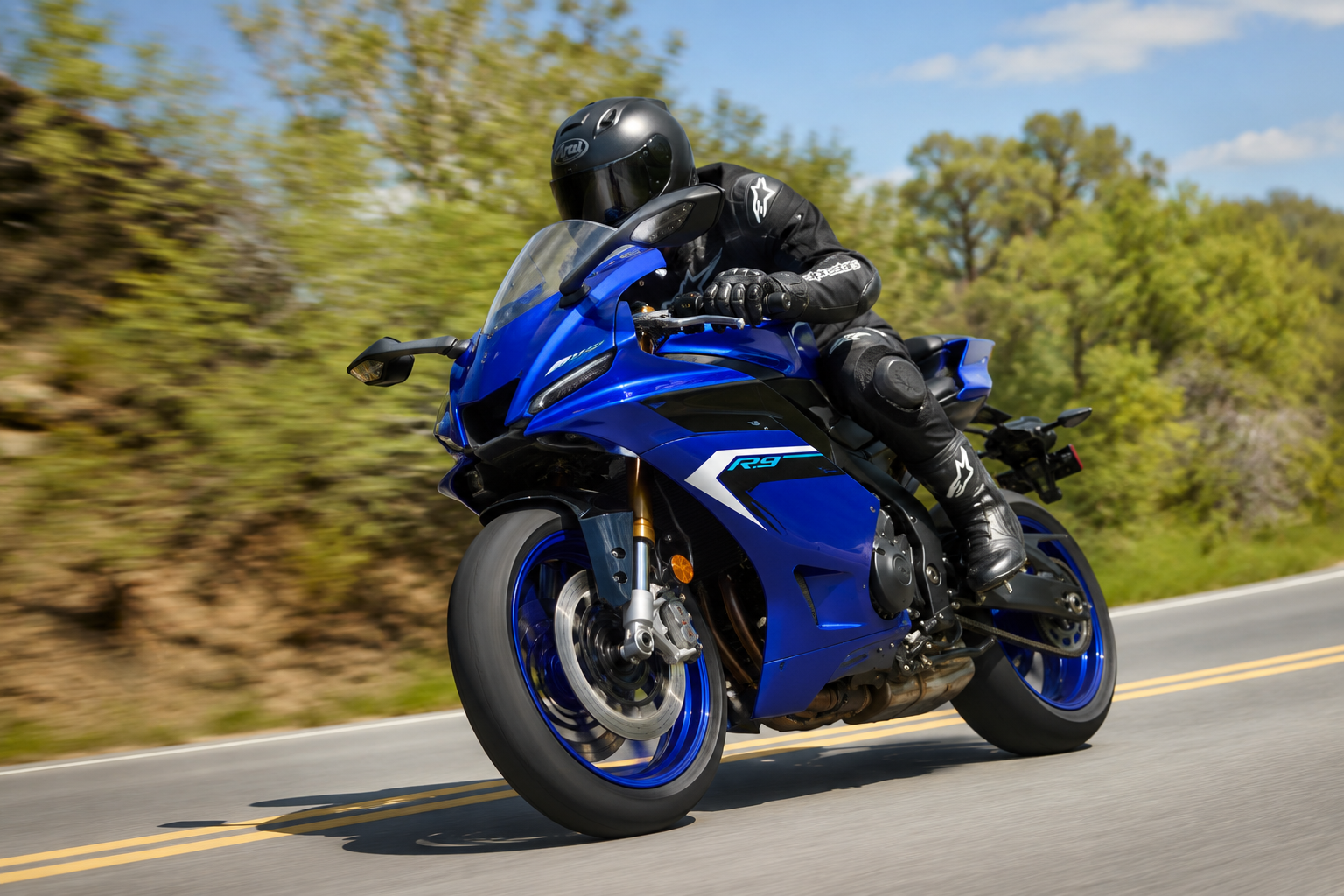
The R9 is not an R1 replacement. It is not trying to be a 190 rear-wheel-horsepower superbike. It is also not just an MT-09 with fairings. The R9 sits in the space between the R7 and R1, giving riders a more serious sportbike chassis, a very usable CP3 engine, strong electronics, and enough performance to be fun without being overwhelming.
Does it have insane power? No. Does it have enough power to be a very fun bike? Absolutely.
More importantly, the R9 responds extremely well to tuning in the areas that matter most in real riding: lower gear throttle response, partial throttle, RPM extension, smoother shifting, cooler fan operation, and more consistent power delivery.
What the Yamaha R9 Is Supposed to Be
The Yamaha R9 uses Yamaha's 890cc CP3 three-cylinder engine, the same general engine family found in the MT-09. Yamaha claims around 117 horsepower and 68 lb-ft of torque, which places the R9 well above the R7 but far below the R1.
That middle ground is exactly the point. The R7 is approachable, affordable, and easy to ride, but it is clearly limited in power. The R1 is extremely fast, expensive, and much more motorcycle than many riders need on the street or even at a casual track day. The R9 fills the gap between them.
For around the $12,500 price point, the R9 gives riders a lot of motorcycle:
• 890cc CP3 inline-three engine.
• Six-axis IMU.
• Traction control.
• Slide control.
• Lift control.
• Multiple ride modes.
• Customizable Yamaha Ride Control settings.
• Cruise control.
• Bluetooth connectivity.
• KYB front and rear suspension.
• Brembo Stylema front calipers.
• Modern TFT dash.
That is a strong value package. The R9 looks aggressive, has real electronics, and gives riders a more planted sportbike feel than the R7 without stepping into full liter-bike territory.
R9 vs. R6: Is This Really the Replacement?
The R9 is the closest thing Yamaha has given riders to an R6 replacement, but it does not feel like an R6 copy.
The old R6 was a high-revving 600cc inline-four. It made power at the top of the tach and needed RPM to feel alive. It was sharp, light, flickable, and extremely rewarding on track, but it did not have much low-end torque for street riding.
The R9 changes that formula. It has more displacement, more torque, and a much stronger low-to-mid-range feel. The CP3 engine gives the R9 roughly 20 lb-ft more torque than the R6, and that difference is obvious when leaving a stoplight, rolling through traffic, or driving out of slower corners.
The tradeoff is that the R9 does not flick side to side exactly like an R6. It feels a little longer, a little lower, and a little more planted. That makes it slightly less eager to flop into a corner, but much more stable once it is leaned over.
For a lot of riders, that is a good trade. The R9 gives up some pure R6 sharpness, but it gains confidence, torque, and street usability.
Stock Ride Feel
In stock form, the R9 is a very good motorcycle. Light-to-light riding feels easy because the CP3 engine has enough torque to move the bike without needing to rev it out constantly. The seating position is sporty, but not as punishing as a full race replica. The dash is clear, the electronics are robust, and the brakes are excellent.
The Brembo Stylema front brakes are one of the best parts of the bike. They feel strong, controlled, and very well matched to the R9's power level. The KYB suspension also handles rough Southern California roads better than expected for a sportbike.
The chassis is confidence-inspiring. The R9 is not as flickable as an R6, but it feels extremely planted in corners. That makes it a good platform for riders who are still learning how to carry speed through turns. Once the bike is leaned over, it feels predictable and stable.
The stock exhaust is the weak point. It is quiet, large, and restrictive. The sound from the bike is mostly induction noise rather than exhaust note. The exhaust has a large underbody design and does not give the CP3 engine the character it deserves.
The other issue is a noticeable restriction in the lower RPM range, especially in the lower gears. Around 6,000 to 7,000 RPM, the bike feels like it wakes up suddenly. Before that point, there is a lazy section where the throttle feels held back. That is one of the main areas the Stage 1+ flash improves.
Stock GPS Testing
Before flashing the bike, we tested the R9 on GPS using Dragy. The goal was to measure how fast the bike actually accelerates on the road, not just what it shows on a dyno graph.
Stock, the R9 produced the following results:
Test | Stock Result |
20-100 mph | 7.2 seconds |
60-130 mph | 9.5 seconds |
GPS top speed in test area | 141 mph |
← Swipe left / right to view full table →
Those numbers are not superbike numbers, but they are a useful baseline. The R9 is not trying to be an R1. It is a middleweight sportbike with a torque-focused triple-cylinder engine.
The most important stock result was the 20-100 mph test. Because the run starts low in second gear, it exposes lower-gear restrictions very clearly. The R9 felt lazy at the beginning of the pull, then picked up harder once it got closer to the 6,000-7,000 RPM range.
That confirmed what we felt on the road: the engine itself has more to give, but the stock ECU calibration is holding back throttle and torque delivery in key areas.
Stock Dyno Results
On the dyno, the stock R9 made 110 rear-wheel horsepower and 66 lb-ft of torque with the stock exhaust system.
That is a healthy result for a completely stock 890cc three-cylinder sportbike. The R9 does not make power like a 600cc inline-four. It has a much broader torque curve and feels more like a smaller liter bike in the way it delivers usable drive through the middle of the rev range.
Still, the stock dyno graph showed room for improvement. The curve had some uneven areas that needed smoothing, and there was a clear restriction up top where the power dipped instead of carrying cleanly. That restriction matched what we felt during road testing.
The stock AFR was not terrible, but the power delivery could be cleaned up. The biggest improvements were not expected to come from peak horsepower. They were expected to come from throttle mapping, torque management, RPM extension, and partial throttle response.
BT Moto Stage 1+ Dyno Results
After flashing the R9 with the BT Moto Stage 1+ calibration, peak power increased from 110 WHP to 113 WHP on the stock exhaust setup, with torque moving from 66 WTQ to 67 WTQ.
Setup | Wheel Horsepower | Wheel Torque |
Yamaha R9, stock ECU, stock exhaust | 110 WHP | 66 WTQ |
Yamaha R9, BT Moto Stage 1+, stock exhaust | 113 WHP | 67 WTQ |
← Swipe left / right to view full table →
Peak-to-peak, that is not a huge number. But judging this flash only by peak horsepower misses the point.
The tuned graph showed more power at the top where the stock bike had a restriction. In that restricted area, the difference was much larger than the peak number suggests. The flash also extends the usable RPM range, allowing the rider to carry a gear farther before shifting.
On track, that matters. Less shifting means fewer interruptions, more control, and cleaner corner exits. Even when the peak number only changes slightly, a wider and smoother powerband can make the bike faster and easier to ride.
Partial Throttle Gains Are the Real Story
The biggest Stage 1+ improvement is partial throttle. That is where the R9 changes from feeling restricted to feeling alive.
At 25% throttle, the tuned file showed roughly 4-6 wheel horsepower gains through much of the tested range. At 50% throttle, the difference became much more obvious, with a major restriction removed near the top of the pull. At 75% throttle, the stock file showed an even larger restriction, with the tuned file picking up more than 25 wheel horsepower in the restricted area.
That is why the bike feels so different on the street after flashing. Most riding does not happen at wide-open throttle. It happens at partial throttle:
• Rolling away from stoplights.
• Driving out of second-gear corners.
• Passing traffic.
• Holding steady throttle mid-corner.
• Rolling on from low RPM.
When those areas are restricted, the bike feels lazy even if the peak dyno number looks acceptable. Once those restrictions are removed, the same engine feels sharper, more responsive, and more predictable.
What the BT Moto Stage 1+ Flash Changes
The BT Moto Yamaha R9 Stage 1+ ECU Flash is designed to unlock the areas Yamaha leaves restricted from the factory. The goal is not just to chase a peak dyno number. The goal is to make the bike feel better everywhere.
Key changes include:
• Throttle de-restriction in lower gears and other restricted areas.
• Torque limiter changes for more direct power delivery.
• Fueling changes at idle, part throttle, and full throttle.
• Ignition adjustments for stronger torque delivery on pump fuel.
• Extended RPM limiter for a wider usable powerband.
• Extended top speed limiter toward aerodynamic limits.
• Lower cooling fan activation temperatures to help the bike run cooler.
• Smoother on/off throttle behavior for better corner entry and exit feel.
• Quickshifter refinement for smoother upshifts and downshifts.
• Compatibility with most exhaust systems and filters.
The handheld tuner also makes flashing simple. On the R9, access is easy. Remove the rear seat, remove the small plastic panel with the push clips, connect the diagnostic cable, and flash the bike through the handheld.
There is no need to remove and mail the ECU. The handheld can also read and clear check engine lights, store multiple maps, return the bike to stock, and support future changes if the rider adds an exhaust or other modifications later.
Post-Flash Ride Feel
After the flash, the R9 feels like the bike Yamaha should have delivered from the factory.
The biggest change is second gear. Stock, the bike felt dull at lower RPM in second gear. After tuning, the same throttle input produces stronger drive. The engine responds immediately without the lazy dead zone that showed up before.
Throttle response improves without becoming twitchy. That matters because a bad tune can make the throttle feel like a light switch. Too much response at tip-in makes a bike harder to ride smoothly, especially mid-corner. The R9 flash keeps the initial throttle connection controlled while still giving the rider much stronger response once throttle is applied.
The bike also feels smoother during upshifts and downshifts. The engine braking and fueling transitions feel more refined, and the quickshifter feels more sorted under load.
Cooling behavior also improves. In stock form, coolant temperature would sit around 222 degrees before the fan strategy brought it down. After the flash, fan activation happens earlier, with the bike cooling down sooner and spending less time at higher displayed temperatures.
Post-Flash GPS Testing
After tuning, GPS testing showed a major improvement in the exact area where the stock bike felt restricted.
Test | Stock | BT Moto Stage 1+ |
20-100 mph | 7.2 seconds | 6.2 seconds |
60-130 mph | 9.5 seconds | 9.2 seconds |
GPS top speed in test area | 141 mph | 144 mph |
← Swipe left / right to view full table →
The 20-100 mph result improved by a full second. That is the number that best shows what the tune changed. The run starts low in second gear, exactly where the stock bike felt held back. Once the lower-gear restriction was removed, the bike accelerated much harder through that part of the pull.
The 60-130 mph test improved by three tenths. That is a smaller gain because that test lives more in the upper-speed range where the R9 is already approaching the limits of its stock-exhaust power. Still, the extended RPM and cleaned-up top-end helped the bike carry speed better.
Top speed in the same test area improved from 141 mph to 144 mph GPS. The dash was showing closer to 150 mph, but GPS is the number that matters. The bike may be able to run slightly higher with more room, a lighter rider, better conditions, or a full exhaust system, but the test showed a clear improvement in the same distance.
Why the Stock Exhaust Holds the R9 Back
The stock R9 exhaust is extremely restrictive. It is large, quiet, and built around emissions and sound compliance. During dyno testing, the exhaust design made it difficult to get a clean sample because of the way the outlet is shaped and because so much of the system is muffler and catalytic converter.
That matters because the CP3 engine responds well to airflow changes. The R9 is already making decent power stock, but the exhaust is clearly limiting how much can be gained with tuning alone.
When comparing the R9 to a 2025 MT-09 with a full exhaust system on the same dyno, the MT-09 showed how much difference an exhaust can make on the CP3 platform. Even though the R9 and MT-09 use the same general engine family, the stock R9 exhaust is holding back power.
That is why Stage 2 testing with a full Akrapovič system is the logical next step. Once the exhaust restriction is reduced, the R9 should be able to make better gains across the curve and especially up top.
R9 vs. R7
The R9 is a major step above the R7 in power, electronics, and overall capability.
The R7 is still a good motorcycle. It is lighter, cheaper, simple, and approachable. Its CP2 twin has friendly low-end torque and makes sense for newer riders or people who want a basic sportbike platform.
But the R7 is clearly lacking in power compared to the R9. The R9 has more engine, more electronics, better brakes, more technology, and a much stronger performance ceiling.
If the R7 feels like not enough bike, but the R1 feels like too much, the R9 is the correct answer. It gives riders the middle ground Yamaha was missing.
R9 vs. R1
The R9 is not an R1 replacement.
The R1 is still a much faster motorcycle. With a full exhaust and tuning, an R1 can make around 190 rear-wheel horsepower. It has more RPM, more power, more torque, and a much more aggressive superbike character.
The R9 is not trying to match that. It is trying to give riders something that feels sporty, modern, and exciting without the cost or intensity of a liter bike.
For riders who want maximum performance, the R1 is still the better choice. For riders who want a more manageable sportbike that can still carve canyons, run track days, and feel exciting on the street, the R9 makes more sense.
R9 vs. Daytona 660
The Triumph Daytona 660 is another strong middleweight option, but the R9 has a clear performance advantage.
The Daytona 660 is less expensive and has a great three-cylinder character. It is also faster than many people expect, especially compared to the Yamaha R7. But the R9 has more displacement, more torque, and stronger acceleration.
In BT Moto testing, the Daytona 660 was roughly one second slower from 20-100 mph than the flashed R9. That is a meaningful difference. The Daytona is a good bike, but the R9 is the stronger performance platform if the budget allows for the extra cost.
Is the R9 a Good Starter Bike?
For the right rider, yes.
The R9 is not a beginner bike in the same way a 300cc or 400cc motorcycle is. It still makes real power, and it is still a full-size sportbike. But compared to an R1 or other liter-class machines, the R9 is much easier to manage.
The power is strong but not overwhelming. The electronics are excellent. The chassis is stable. The brakes are high quality. The bike gives the rider confidence instead of constantly trying to get away from them.
That makes it a great learning platform for someone who wants a serious sportbike but does not want the intensity of a liter bike. It is also a good track-learning bike because the rider can focus on body position, braking markers, apexes, and throttle control without fighting excessive horsepower.
What the R9 Still Needs
The R9 is a strong package, but it is not perfect.
The first thing it needs is an exhaust. The stock system is too quiet, too large, and too restrictive. A proper exhaust will help unlock more power and give the CP3 engine the sound it deserves.
The second thing it could use is a steering damper. Once the lower-gear restrictions are removed and the bike makes more power in second gear, the front can get light coming out of corners. A steering damper would add confidence and reduce the chance of unwanted headshake.
The third area is airbox testing. Like the MT-09, the R9 may have more intake restriction that can be improved. Once the full exhaust is installed, airbox development becomes the next logical step for Stage 2 testing.
Final Verdict: What the Yamaha R9 Really Is
The Yamaha R9 is one of the most important bikes in Yamaha's current sportbike lineup. It gives riders a real middle option between the R7 and R1, and it does that with a strong CP3 engine, good electronics, excellent brakes, and a planted chassis.
Stock, it is already a very good motorcycle. It has enough torque to be fun on the street, enough chassis to be confident in corners, and enough electronics to make it approachable for a wide range of riders.
Flashed, it becomes the bike it should have been from the factory.
The BT Moto Stage 1+ calibration removes the low-gear restrictions, improves throttle response, extends the usable RPM range, lowers fan activation temperatures, smooths shifting, and makes the bike much more responsive in real-world riding.
The peak dyno gain with the stock exhaust is modest, but the real-world improvement is not. A full second faster from 20-100 mph is a major change, and that result shows why street testing matters just as much as dyno testing.
The R9 does not have insane power, but it does not need it. It has enough power to be fun, enough torque to be usable, and enough chassis to keep riders confident.
For riders who think the R7 is not enough and the R1 is too much, the Yamaha R9 is exactly where they should be looking.
For Yamaha R9 Stage 1+ ECU tuning, at-home flashing, and future support for exhaust and Stage 2 setups, visit the BT Moto 2025-2026 Yamaha R9 Stage 1+ ECU Flash with handheld tuner page or contact the BT Moto team to match the calibration to your bike and modifications.
Recent Posts
Related Posts

How to Locate Dyno Tuning Near Me
ByRick Simpson.12 Oct 2026

Difference Mail In vs OBD Flash
ByRick Simpson.12 Oct 2026
.jpg)
2023 BMW M1000RR Review: The Ultimate Riding Experience
ByRick Simpson.12 Oct 2026